This post may strike a dissonant chord with the companies and groups that I am going to mention, but I feel that the state of the volunteer yDNA research projects, as handled by FamilyTreeDNA, has gotten out of hand. The issues do not stem from the surname project admins (though I have found one to be of specific concern), but rather the information provided by the yDNA testers who join the projects.
Further, it is not all of the participants who are the issue, only those who make unsubstantiated claims of having identified yDNA that originates from a person from very far back in history that gave rise to large populations.
When one takes a yDNA test at FamilyTreeDNA, an option is provided to document your earliest documented ancestor on your male line:
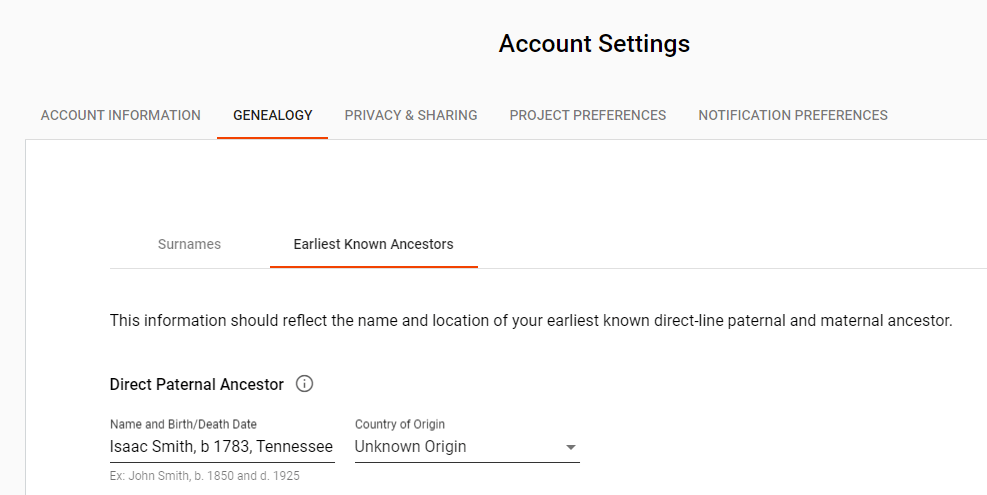
Here we see that, if so desired, anyone can enter anything in these fields.
Motivation to make this post partly came from the recent discovery of kit “364732”.
They appear to make a claim of being descended from the “Butlers of Ormond”. On their part, I know this is not a true statement.

A quick search of Google yields that the person who manages this kit has published this claim in nearly every surname project at FamilyTreeDNA.
It should be very obvious the damage a situation like this can do to the genetic genealogical research efforts.
From what I know about the story behind “364732”, they do not have any paper records to support their claim of descent from the “Butlers of Ormond”. They have also demonstrated a lack of solid understanding of yDNA inheritance.
An inquiry into the Butler Surname Project at FamilyTreeDNA resulted in me being told that the kit manager was advised to reach out to me directly to resolve this matter. While, by proxy, I have provided them my name, e-mail address, and links to my blog and WikiTree project, I have yet to hear from them or see that their information has been corrected.
The core of this problem arises from how the volunteer projects are populated with information. NPEs aside, anyone can make a claim of descent from any family and simply affix their yDNA to that claim, sans proof. Some projects do provide forums within which discussions can be had to further explore topics among group members, but that is not a standard, nor is engaging in discussion about one’s ancestry required if mentioned.
We now see how the system is flawed. Anyone can make a claim about their yDNA, and that claim can be widely published, all without supporting evidence. Essentially, anyone who takes a yDNA test can now attempt to misappropriate the story of the genetic origins of larger male populations. This can end up affecting the research of many families.
A simple fix for this could be to enforce data formatting constraints for the “Direct Paternal Ancestor” field in the FTDNA User Profile to limit values to a first, middle and last name with vital info in separate fields. As of now, it appears FTDNA simply accepts a generic string.
In inspecting SmithsWorldWide.org, we see this matter become even more complex. I have found about 7 or 8 groups who, when the claims of historical relevance of their yDNA to larger populations is examined, are found to be in conflict with each other. I will not go into those details here, but I can detail for you how peer review and challenges to published claims on their site are handled.
SmithsWorldWide.org provides a place where yDNA test takers, after already being matched to their cousins at FamilyTreeDNA, can begin archiving and organizing their Smith family research for their larger yDNA matched population. The main issues stem from how those groups are created and managed in the long-term.
The scenario I see happen frequently is that, in the early days of yDNA testing at FTDNA, some earnestly interested and knowledgeable family researchers organized yDNA studies for their larger populations. These people, usually much older in age, were the first to act as “group contacts” for their yDNA groups. Unfortunately, over time, these original resources pass away and the task of navigating and updating the information in the various groups falls on whomever is willing to take up that mantle. However, there are situations where not every group has someone willing and/or able to assume the role that is now left unmanned with the prior family researchers’ passing. Further, not everyone who is able to simply click on the “Join” button of the surname project is willing to learn how to work with the SmithsWorldWide.org application.
This can lead to a number of things happening. There can be data stagnation (nothing new is learned about the groups), there can be inability to correct bad information (the site admins refuse to examine trees, sources, and analyses for accuracy or get involved in challenges), and broader claims of understanding the ancestral origins of the yDNA lines may be incorrectly posted and unable to be challenged. To compound things, SmithsWorldWide.org does not require autosomal analyses to show two people were related, but they do allow atDNA kits, without analysis, to join the various groups. I have at least one case where a person related to my Smith group was added to an incorrect group. This is quite likely happening in other groups as well. How would you feel if you were told a group of people were related to you when, in fact, they were completely unrelated?
The main way group research is effectively coordinated on SmithsWorldWide.org is there are usually one or two group researchers who field all communication about their group’s story and information. Unfortunately, due to the aforementioned issue of “anyone can claim anything about their yDNA without proof”, we are left with the functional design of relying on trusting the yDNA group members and contacts/researchers (different from the surname project admins) to be capable of doing the necessary research, it being of sufficient quality, and to be working in good faith.
Effectively, if one were to challenge a yDNA group’s published claim at SmithsWorldWide.org, if the group contacts do not agree with you, even if you correct and have proof, they are under no obligation to correct their group’s errant published information.
With sites like SmithsWorldWide.org, while they are not a member as far as I am aware, the issue with “364732” is exacerbated. We now have a situation where, if challenged, even with evidence, unless the group contacts concede, corrected information will not make it’s way into their application. We should keep in mind that DNA testing can be used to test the validity of books and other sources.
SmithsWorldWide.org is largely viewed as a semi-authoritative source for the historical context of yDNA information. I have had other researchers cite their pages, which were in those instances incorrect, when discussing topics relevant to my research.
So what do we do then? We now approach a larger online system that suffers from, though likely not wide-spread, an effective removal of all checks, qualifications, and challenges on what information is attached to yDNA results, and relies solely, in some cases, on the good faith of yDNA test takers to populate their earliest direct paternal ancestor accurately and honestly in their FamilyTreeDNA profile and on family researchers to act in good faith.
This chain has a few weak links.
Thanks for reading,
Chris
 Tracing my Smiths - by Christopher A. Smith - © 2021
Chris, I rarely look at genealogy/pedigree database internet sites these days as all too often the information and relationships are either unsourced or incorrect. Sad to say, this seems to be more of an issue when generated on your side of the pond, possibly due to limited access to original sources in the UK and an over-enthusiastic desire to be connected to the UK’s nobility.
Over recent years, I have even come to learn not to trust information published by highly regarded antiquarians (which so many rely on as their source) as I keep discovering so many errors in such works. Indeed, I am in the process of publishing an article to resolve the flaws in the Folville pedigree published in the late-nineteen/early-twentieth centuries by eminent and respected authors such as John Nichols and George F. Farnham. Consulting original medieval manuscripts has certainly honed my skills in transcribing and translating latin documents!
Interesting you cite an example concerning the Earls of Ormond, as one of my ancestors (John Dansey) was instrumental in delivering seisin to James Butler, 5th Earl Ormond, of his inheritance left by his grandmother, Joan Beauchamp, Lady Abergavenny. I have attached a short extract from another publication of mine, which mentions the involvement.
Regards, Dave
On Fri, 1 Jul 2022 at 06:26, Tracing my Smiths – by Christopher A. Smith –
LikeLike
Your point is well covered. But, there are the same problems with the mtDNA and atDNA sites. Claims are made with no more consideration than “well, I found it posted by someone else, I really do not know where it comes from”. I tend to ignore pedigree claims unless I can confirm them with proper citations. This is true on all sites, for all DNA testing companies. I get confounded when I see someone post that they just got their results, now tell me what to do. If they have no idea what to do, why, oh why, did the spend their hard earned money on it?
LikeLike