Update: My second installment at chipping away at Round’s arguments can be found here:
Before I get to the heart of J H Round’s work, I wish to preface this writing.
Recently on Geni.com, I have been engaged in a discussion regarding the facts surrounding John Carrington alias Smyth who is said to have been buried in Rivenhall Churchyard in Essex in June of 1446. Contributions from everyone have been much appreciated.
I’ll start by listing my sources starting earliest to most recent:
William Dugdale – The Antiquities of Warwickshire, Illustrated [vol1] [vol2]
Philip Morant – History and Antiquities of Warwickshire
William Arthur Copinger – History of the Records of the Smith-Carington Family
(derived from the archives of Mr. Robert Smith-Carington*,**)
John Horace Round – Peerage and Pedigree
Lionel M. Angus-Butterworth** – Old Cheshire Families and their Seats
Clarke and Hodgeson – Leicestershire Pedigrees and Royal Descents
* I wish to make it known that Mr. Robert Smith-Carington adopted the hyphenated surname himself. He seemed determined, even if impossible, to connect his Smith line to the Smiths of Rivenhall.
** I also wish to state that it is my opinion that the Smiths of Cropwell, Tithby, Nottinghamshire, ancestors of the Smiths of Smith Bank & Co. are not likely descended from the Smiths of Rivenhall. All of the above authors will inevitably have conflicting opinions of things.
My primary “adversary” in this story has been a one Erica Howton (and more recently Andrew Lancaster), a woman who curates the Geni.com profile for a number of individuals I find myself researching these day, and stands firm with J H Round on his opinion that the Smiths of Rivenhall were not descended from the Carringtons of Cheshire. Erica has been a very active contributor on Geni.com and is a curator for many of the profiles that pertain to the individuals who were associated with John Smyth, Esq. of Rivenhall, Essex. Amy Nordhal Cote has also been a valued contributor by proving research avenues that may not be immediately obvious to someone who is, for the first time, seriously researching John Carrington alias Smyth. Both individuals have demonstrated their skill in finding obscure information on the internet regarding our subjects of research.
(I may periodically update this page with new or corrected information, so this is a disclaimer.)
Ok, to the heart of the matter! Fortunately for me John Horace Round did me the favor of organizing his points of argument in his book. Due to the volume of his commentary, I must post my analysis in two parts. Here I begin with the first half of my criticism of “The Great Carrington Imposture” by John Horace Round.
I have organized this list according to the talking points Round set out at the beginning of his work.
Please bear with me. This is a lot of information. Some entries are simply facts, others commentary.
–BEGIN–
Brown, Jones, and Smith
- Suggests for “Smith” lines there is no “hope” in proving a “noble” ancestry
- Calls Smith a “distressing” name
The two John Smiths
- Makes allusion to Smiths of Hill Hall and their suggested Plantagenet connection
- Admits that the two Smith lines’ histories are irrelevant to each other’s as a matter of proving either lineage credible.
- Suggests that John Smith of Hill Hall’s son, Sir Thomas Smith of Hill Hall (professor), fabricated a pedigree so that, after rising to the prominent position of Vice-Chancellor of Ely, he could inherit a coat of arms.
- He also suggests that the suggested narrative of how John Shakespeare’s coat of arms was obtained has a bearing on Sir Thomas Smith of Hill Hall. (I have no information on William Shakespear’s coat of arms.)
- He clearly is making assumptions about completely unrelated families and lineages based upon other completely unrelated families. Each line must be examined individually for any analysis of their lineages to be credible. He is comparing apples to oranges in my opinion.
Three Smith families claim to be ‘Caringtons’
- Begins with an attack on the Smiths of Cressing Temple by saying “It was not, as a rule, the founder of the house who indulged in these fantasies: he knew from what he had risen, and other knew it too.”
- This is incredibly smug of Round. I feel like it is him saying “You know you’re lying! Quit pretending!”
- His references to “Barker” are marked with an air of skepticism. I believe he is suggesting that this officer issued arms to fabricated lineages frequently enough to make anything attached to his name incredible.
[Here I digress, but the subject matter is not completely uninteresting or irrelevant. I wish to show the credibility of the individual Round is so ready to criticize. ]
- “Barker” appears to have been a Christopher Barker, son of William Barker of North Riding, Yorkshire. He started as a private officer of arms of Charles Brandon and was later made “Lisle pursuivant” in 1513, and “Suffolk Herald” in 1517. In 1522 he was made a royal officer of arms as “Richmond Herald” and later still was promoted to “Norroy King of Arms”. On 15 July of the same year, he was promoted to “Garter Principal King of Arms”. (from WikiPedia)
- Please note that Round was never directly involved with The College of Arms in any capacity and independently published all of his works, some resulting in a “level of acrimony [that] was sufficiently high [enough] that the editor was forced to close correspondence on the subject.”
- Barker’s evidence during the trial of Henry Howard, Earl of Surry was integral in the Earl being found guilty of a “charge of treasonably quartering the royal arms”.
- The Howards had little regard for “new men” such as Cromwell and Seymour. His trail and subsequent execution were during the time of Henry VIII, a man paranoid about the possibility of Henry Howard usurping the throne. You see, Henry Howard was descended from kings on both sides of his tree. His mother from Edward III, his father Edward I.
- Henry Howard was reared with the illegitimate son of Henry VIII, Henry FitzRoy (a man we later find was born at Blackmore Priory, a placed Henry VIII frequented to engage in extramarital affairs. Henry VIII referred to Blackmore Priory as “Jericho”, the same priory that became a possession of the Smiths of Blackmore, descendants of the Smiths of Rivenhall.
- Not to digress further, but Henry FitzRoy was a son of a Elizabeth Blount, a daughter of a Sir John Blount and Catherine Pershall.
- Is it not interesting we find a connection to “Jericho” and a Blount line in this narrative? [See the Smith, Croke, and English story]
- Round is saying that the man who provided evidence for the execution of Henry Howard granted arms to the Smiths of Cressing Temple, a family who Round is claiming were “new men” and supposedly would not have been liked by Henry Howard. Does Barker intentionally kill an Earl and forge some pedigrees for some folks who came into new money? Not likely.
- Round is trying to cast doubt on the credibility of the lineage of the Smiths of Rivenhall by pointing to a narrative involving a herald who helped to convict a (at least perceived) rival of Henry VIII (a much larger picture) and not the facts surrounding their Smyth lineage.
- Smiths of Cressing Temple were related to Smiths of Saffron Walden
- Sir Charles Smith is Lord Carrington in the year 1643.
- Round wishes to suggest that since there is more than one family making a claim to a descent of the Smiths of Rivenhall that the Carrington/Smith lineage is fabricated.
- A Mr. Richard Smith, a successful businessman, adopts the surname “Smith-Carington” in 1878.
- Richard Smith was the original possessor of the archives later entrusted to Dr. Walter Arthur Copinger, LL.D., F.S.A., Professor of Law at Victoria University.
- It can be shown, in agreement with Round, that the John Smith of Cropwell, Tithby in Nottingham is not descended from any Smith of Ashby-Folville, but an earlier John Smith of Cropwell, Tithby dying circa 1602.
- This John Smith is the progenitor of the Smiths of Smith Bank & Co, the ancestors of the most modern incarnation of The Lords Carrington.
- We must make sure we remember that Mr. Robert Smith”-Carington” not being descended from the Smiths of Nottingham, and they in turn not being descended from the Smiths of Rivenhall, does not itself discredit the suggested ancestry of the Smiths of Rivenhall.
- He prefaces his next section by stating that he can prove the Smiths of Rivenhall are not descended from John Carrington of Cheshire. Then, after “proving” this, he will discredit the other artificially affiliated Smith lines with the Smiths of Rivenhall. Again, proof of a lack of a connection from (A) the Nottingham Smiths to (B) Mr. Robert Smith-Carington, and from (A)/(B) to (C) the Smiths of Rivenhall does not itself discredit the claim of descent of the Smiths of Rivenhall from the Carringtons of Chester.
The Conquest ancestor
- Round first attempts to “disentangle” i) the (according to Round) “16th century fabrication” that is a personal account (by John Carrington alias Smith) of the ancestry of the Smiths of Rivenhall being descended from Sir Mychell of Carrington from ii) the descent of Hamo de Carington.
- Round first states that, after an enquiry to The College of Arms, there is no recorded descent from “Sir Mychell” to the family of Mr. Robert Smith-Carinton. I will agree with this, but this does not discredit the existence of “Sir Mychell of Carington”. It simply shows that Mr. Robert Smith-Carington does not have strong evidence to lay a claim of descent from the Smiths of Rivenhall.
- Further, an audacious claim made by Mr. H. H. Smith-Carington, that he is “the heir male of the senior line” is specious at best. We know this is not true.
- Round then goes on to attack the existence of Hamo de Carington himself by saying “Not a scrap of evidence is produced to show that this Hamo de Carington ever existed in the flesh, and I do not hesitate to say that he is a fictitious personage.”
- This claim can be solidly countered by the following evidence. After Round, a gentleman by the name of Lionel M. Angus-Butterworth authored a work on the Smith/Carrington pedigree. Regarding the matter of Hamo de Carington, he provided the following transcript of a record pertaining to Sir Jordan of Carington, a suggested grandson of Hamo of Carington.
- Taken from Butterworth’s book: “Upon the death of Hamo the lordship of Carington passed to his son and heir Sir William de Carington, who was succeeded by his son Sir Jordan, [described as] “ fil Willielmi fil Hamonis de Carington.” This Sir Jordan was one of the Knights of Ranulph de Gernon, fourth Earl of Chester, and was present at the battle of Lincoln, the 2nd Frebuary, II4I, when King Stephen was taken prisoner.
- This information will be easily verifiable. Further, Butterworth cites “an early ‘Armorial General de France’ deeds and other papers in the municipal archives of Rouen [in Normandy, France], and the publications of the ‘Société de l’Historie de Normandie’ ” as his source. This undoubtedly will prove to be credible.
- Rounds claim of Hamo de Carington being a “ficticious personage” has been strongly countered.
- Further, Round goes on to suggest that Hamon de Masci and Hamon de Carington are one in the same. This appears to be from an apparent lack of mention of Carington in the Domesday survey. An analysis of the relevant records show that “Carington” was indeed omitted from Domesday. However, the source for the lineage of Jordan de Carington shows that Hamo de Carington was not described as Hamo de Mascy (Hamon de Masci). Baron Hamon De Masci had his own heirs and is mentioned specifically as a variant of “Hamo de Massey” in these records. I cannot believe that one individual would be mentioned by two different names when describing lines of descent and matters of inheritance.
- Round then goes on to (again) make a comparison between the lineage of Mr. Robert Smith-Carington (specifically the lineage of his mother, a Hanbury) and the identity of Hamo de Carington and Hamo de Massy. The suggestion is that since one line is contrived, the whole of the identity of Hamo de Carington is fabricated. This is not sound logic. Again, each lineage must be exclusively analyzed for credibility. A failure of genuineness on the part of one line does not constitute a strong case for fabrication of another.
The 16th century document
- Round first sets out his vectors of attack. I) the Carington pedigree down to “John Carrington” and ii) the provenance of the origins of the Smith name as it came to be associated with a descendant of a Carrington of Cheshire.
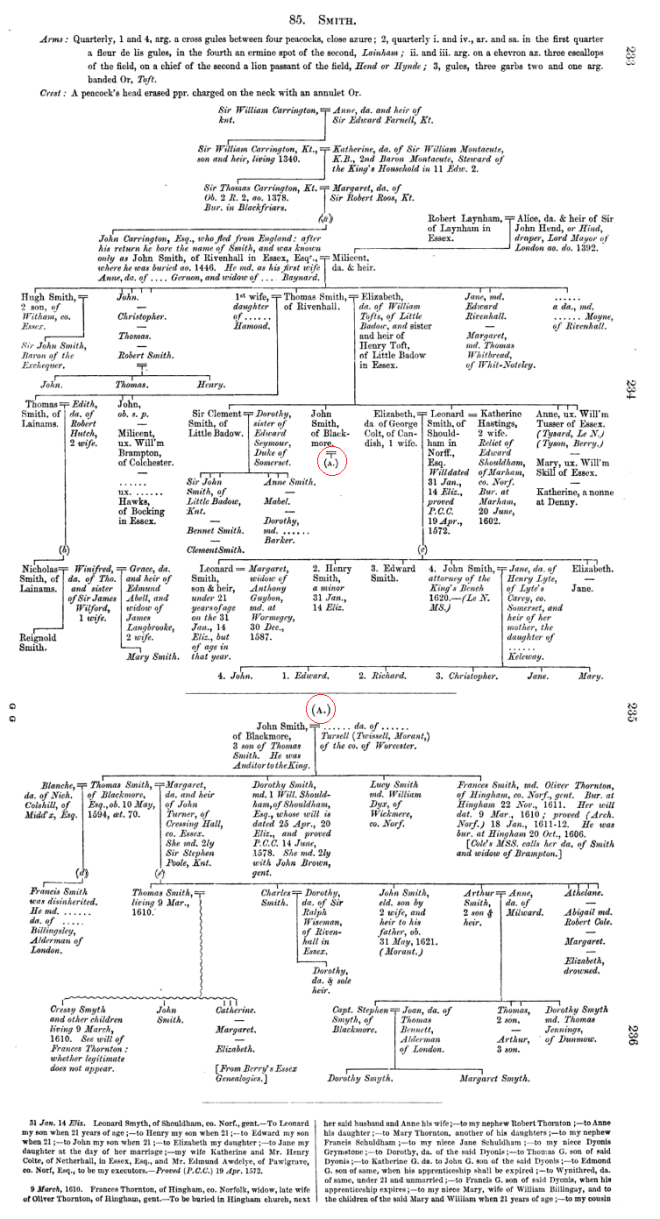
- Round describes when the Smith/Carrington pedigree was first recorded, in 1577.
- Sir John Smith of [Little] Baddow in Essex brough to Cooke, Clarencieux of the College of Arms “two ancient writings”. One was provided by the aforementioned “John Smith of Baddow”, the other by “Henry Smith of Cressing Temple”. Henry’s heirs were “The Nevills of Holt”.
- Here is what we are having described to us on page 47 of Round’s book: in 1602, Rouge Dragon, a herald, wrote that on 20 May 1577, Cooke, the then Clarencieux, recorded a lineage for the Smiths of Rivenhall, from two sources, one being provided by Henry Smith of Cressing Temple, the other by Sir John Smith of Little Baddow. Later, in 1870, found in the charter chest of The Nevills of Holt [2] was one of these two original source documents used by Cooke in 1577. A Mr. Horwood appears to have been an employee of the “Historical MSS Commission” that rediscovered the record.
- Dugdale is cited as saying that one of the original documents was at one time in the possession of a William Smith, Esq. of Cressing Temple [likely a descendant of Henry Smith of Cressing Temple] and was certified by Sir William Dethick, Knight Garter, the other was in the possession of Sir Charles Smith of Wooten and Ashbye in Warwickshire [likely a descendant of John Smith of Baddow]. Robert Cooke in 1577 certified these documents originally.
- Round agrees that the two documents were “a homogeneous whole”, but insists on challenging the descent of the Smiths from the Carringtons. To restate this a different way, two documents, from two different but related families, agree on their descent from the Carringtons, but Round continues to challenge the claim.
- On page 150, Round “trees out” the John Carrington alias Smith tree.
- I wish to note that Round does not provide source quotations for his trees, but only cites the works that he has read the narratives from.
- What Round is arguing here is weak. He claims that because the lineage that Rouge Dragon recorded differs from what Dr. Copinger recited in his book, the whole of the lineage is fabricated. I will state that this infuriates me as Round dismisses all logic from his argument.
- Keep in mind, as these lineages have been studied, these trees have been changed from a chart of a pedigree into a narrative and back again. When working with very similar names of individuals who are related to each other, undoubtedly, from either strained eyes or an exhausted mind, transcription errors occur. Further, even in this 21st century, even with the introduction of computers, transcription errors in lineages exist.
- Round fails to research himself the discrepancies between Copinger’s and Rouge Dragon’s pedigree charts. If there was a genuine interest in finding the truth of what Robert Cooke recorded in 1577, Round should have investigated. Then again, I am assuming Cooke’s record still exists. Why not go in search of the original documents as recorded by Cooke?
- I will later address the matter of Round decrying the original and handwritten John Smyth of Rivenhall pedigree as fabricated.
All turns on it
- In his attack against the incorrectly recorded trees, Round states “And on this document all depends: its opening words are the only evidence for Sir Michael’s very existence.”
- To counter this, we find a record that an “Adam” or “Adae” of Carington existed. As the source document eludes me, I will refer to where I found the pertinent information, a Geni page that cites a Facebook group! (please don’t laugh…)
- https://www.geni.com/people/Guillaume-de-la-Fert%C3%A9-Mac%C3%A9/6000000003827883045
- This page states that there existed an “Adae de Carrington”, a one time lord of The Manor of Carrington. According to the narrative that Round is familiar with regarding Sir Mychell of Carington (findable elsewhere on the internet), “Adam” of Carrington sold “full half of the Parish of Sale, near Manchester”, lands that the Lordship of Carrington possessed, and funded Sir Michael of Carrington.
- It can be shown through secondary records (transcriptions of primary records) that a Mychell of Carington, a son of Adae of Carington existed. See “The Visitation of Cheshire in the Year 1580”.
- https://books.google.com/books?id=Q_wUAAAAQAAJ&pg=PA170&lpg=PA170&dq=Adae+of+Carington&source=bl&ots=96AQT9GxEZ&sig=BicrS5J6pwvU515wl69kWdfwS9E&hl=en&sa=X&ved=0ahUKEwjF_rK6mMzRAhVBsVQKHbPkDT0Q6AEIJDAC#v=onepage&q=Adae%20of%20Carington&f=false
- “Ego Hamon de Massy dedi Thoma …. Exclam’atem totu Bromi croftum. Testibus Wm de Venables, Hamon fratre suo, Alano de tatton, Rob’to de Massy, Adae de Carrington, Matheo de Massy, Joh’es de Massy”. (Sorry for lack of correct punctuation).
- I will accept as a concession that it is possible Sir Michel existed at one time and possibly had his story embellished. Evidence is required to prove this however.
- If you really want to, you can try to prove that this visitation record is inaccurate, but I highly doubt it is as we find just who we expect to be together, the family of Hamon de Massy and the Lords of the Manor of Carrington.
It is false
- I think I overlapped my arguments for this section somewhere above and below this line.
Sir Michael, the Standard-bearer
- Round states that at the funeral of John Smith, “knight”, in attendance was the then contemporary “Lord Carrington”, his brother.
- Also at John Smith’s funeral, it was proclaimed that John Smith’s Carrington line was descended from Sir Michael of Carrington, the standard bearer.
- This is according to The Somerset Herald.
- On page 154, Round again claims that Sir Michael the standard bearer is a fabrication, an amalgam of personalities of heroic narratives. The relevant sources have been found to show that the dismissal of the existence of Sir Michael of Carrington and Hamo de Carington is illogical.
- I would like to identify any other individuals who may have been “standard bearers” to Richard I. The Henry Tyes (Teutonicus) individual seems an interesting place to start.
- I need to better archive my findings from credible internet sources that pertain to Sir Michael’s profile.
His mythical existence
- Round on page 156 enters into his argumentation about the physical nature of an arguably unrealistic device that is claimed to have transported Richard I’s standard while on the battlefield.
- I feel that Round’s use of this topic as an attempt to dismiss the existence of Sir Michael of Carrington is poor logic. The more relevant nature of the estate records and the like could have been explored, but Round digressed.
- I will argue (as I may while I’m on the topic), in agreement with Round (and see my Geni.com posting under John Smith of Rivenhall) that Copinger is just simply wrong about the nature of the assigned equipment as it pertained to a “standard bearer”.
- There were very large wooden structures that would have been affixed to ships, or even used in an encampment, but as a mobile standard bearer on horseback, engaged on the battlefield, a lance and flag would have been the equipment. It is foolish to think that a lone man would have pushed a large wheeled wooden device around an active battle field.
- See “The Battle of the Standard”. It’s interesting.
- The account of “a car surmounted by a tower as high as a minaret” comes from Bohadin (an Arabic historian).
His ‘costly’ crusade
- Round criticizes the passage at the bottom of page 157.
- Quoting Copinger: “Very little remained after two years to compensate for the loss of Sir Michael de Carington’s life, and the squandering of the proceeds of half the parish of Sale, except a report in the Archives of the Heralds, and an effigy …”
- He states on page 158 “It should prove of the highest interest to historians the more so as Heralds’ College was not even founded till nearly three centuries after the date of the Crusade.”
- I feel that here, Round is arguing with semantics. Copinger perhaps could be referring to a, contemporary (to Sir Michael) report that had thus been, much later, archived with the Heralds’ College.
- Regarding the “debet duos solidos pro eodem”, I need to be careful here. Copinger states that two entries on “De Oblatis Roll” are brothers of Sir Michael: a Mathew and another unnamed sibling.
- So what is “De Oblatis Roll”? Let’s explore what the word “Oblatis” means.
- https://books.google.com/books?id=iepJAgAAQBAJ&pg=PT1003&lpg=PT1003&dq=root+of+oblatis+latin&source=bl&ots=cu3SJL4dXp&sig=_TvKaax6mOacIby1_8Jnn9K98_U&hl=en&sa=X&ved=0ahUKEwi-4ciqqszRAhWIr1QKHa6_Ab8Q6AEINDAF#v=onepage&q&f=false
- “An oblate is a young child offered (oblatus) to a monastery or nunnery by his or her parents. In ecclesiastical Latin the term evokes the idea of a sacrificial gift.” I believe it is the origin of the word “obligation”.
- The roll Round cites appears to be a list of people and how much money they either i) gave as an offering or ii) owe to the crown. The list’s name means either “Obligations” (monies due?) or “(The) Offerings”, or at least this is the best translation I can get from researching Latin on Google.
- I used Google translate to, well, translate “Matheus of Karington debet duos solidos pro eodem.” Google says it means “Matheu of Karington should have two shillings for the same.” I don’t think this is correct.
- After doing some refinement of this enquiry, I find that the sentence likely means something more along the lines of “Matheus de Karington owes (or should owe, or owes you) two shillings ‘for the same’.”
- The word “debet” is derived from the root word “debeo” which means:
- To have or keep from someone
- To owe something, to be under obligation to and for something
- To be bound. In duty, bound to do something; “I ought”, “I must”, “I should”.
- I think it is possible the latin phrase means “Matheus of Karington is obligated to pay two shillings [for the same]”. Whether or not he paid it, I cannot tell. I do not find the word “debeo” or “debet” used to indicate that something was paid for, but rather, only in the sense that something is owed or due. I would like to see the rest of this “De Oblatis Roll”. I welcome a counter argument as I am no expert in Latin but have studied formal Spanish for a number of years.
His alleged relatives
- The relatives of Sir Michael of Carrington are not immediately known to myself. Credible sources that are not derivative works are needed.
–END–
This is the end of my part one of my criticism of “The Great Carrington Imposture” by J H Round. I may even have to break it into three portions.
Update: I have posted my 2nd installment of my criticisms of Round’s work.
-Chris