tl;dr
Round attempts to bear the weight of the (self-resolved) issue of the pedigree of Smiths of Boulcott Lodge on the matter of the pedigree of Richard Smith-Carington.
While the visitation records are sufficient to dis-prove any connection between the Smiths of Boulcott Lodge to the Smiths of Rivenhall, Round is unable to find any information that would either prove or disprove the pedigree of Richard Smith-Carington.
In short, Round is making a conclusion about the parentage of Robert Smith of A[l]sworth, Notts. without sufficient evidence. Further, William George Dimock Fletcher does claim, with details, to have sources for Robert Smith’s family connections to the Smiths of Ashby Folville. Round dismissed these sources. I will not disagree it is difficult to prove, if even suggest, the two Robert Smiths were the same person, however. [Later comments by David J. Lewis do cast strong doubt on the even more ‘recent’ ancestry of Mr. Smith-Carington]
Further, Round places an invalid amount of weight on the fact that Sir John Smith, Baron to the Exchequer, used a different coat of arms than his ancestors. Per the College of Arms, the existence of a hereditary right to ancestral arms to does not prevent a man from being issued new arms that are completely different from his ancestors.
Round should not have used coats of arms to dis/prove any pedigree. [and Mr. Smith-Carington has a rightly questionable pedigree.]
My DNA based research, however, is most closely in proximity to the Smiths of Blackmore, Essex.
Opening
Recently, I came across two discussion threads [1] [2] on WikiTree that involved the topics of the Carrington alias Smith story, again, and found myself again reading the words of Andrew Lancaster who, quite readily, cites and defends the work of John Horace Round on this topic.
Unfortunately, since I engaged him and others in two different threads, the discussion is effectively split between both threads. It may be terribly difficult to follow, but I tried to make each post able to stand on it’s own merit and relevant, as much as possible, to the previously mentioned topics. These alone are worth a read if you are interested in this topic. There were even two folks who tried to completely dismiss the obvious, that is, the value of a 12 marker yDNA test for the previously un-tested male line of Hervey Walteri.
All of this out of the way, the main findings I’d like to discuss in this post pertain to 1) the information available about Robert Smith of A[l]sworth, co. Notts. and 2) the use of coats of arms in Round’s arguments.
Preface
In agreement with Round, I find no evidence to support a connection as described by Dr. Copinger [his book] that the male line of Able Smith of Boulcott Lodge and Smith Bank & Co. is in any ancestral proximity to the Smiths of Rivenhall, Cressing Temple, (Little) Baddow, Wooten Wawen, or Ashby Folville (and possibly a most recently [re]discovered Smiths of Newbuilding, Yorkshire, also of Crosby Temple, Essex, also Sutton Hall in Thirsk ; post in planning. Where the heck was Crosby Temple in Essex?) . This research on the line of Abel Smith was done using visitation records and can be reproduced by anyone willing to take the time to do the work.
(Side note: My hypothesis of the connection between the Smiths of Smithfield, VA to the Smiths of Blackmore, Essex is only challenged by Round’s attack on the John Carrington alias Smith pedigree. I am exploring the full scope of that information for my next post.)
Abel Smith of Boulcott Lodge
Round begins this section after concluding:
- “and nothing henceforth remains of ‘the great Carington imposture’ but Lord Carrington’s title and surname [Nottingham], and the Royal License so strangely granted to the “Smith-Carington” family in 1904 to bear the name their father had ‘assumed in accordance with a tradition in the family [Ashby Folville]’ (Cop p.373)”
- “I am wrong. There remain also Dr. Copinger’s book and those arms with which Ashby Folville has been bespatterd by its possessors, from ‘the public house‘ (Cop p. 423) to the ‘communion plate’ (Cop p. 423).”
Note: These “(Cop p.xxx)” parenthetic citations are for Dr. Copinger’s book.
I will stop here for a few comments. On page 141 of Vol II of Round’s Peerage and Pedigree, he says something that makes me wonder why he even spent any time at all discussing the Able Smith of Boulcott Lodge line.
- “Although the surname and the title alike are based, as I shall show, on a glaring imposture, the family appears to have now [1910?] abandoned any pretense to a descent even from the Essex Smiths, the alleged connection having been disproved, and even vehemently denounced, by Mr Augustus Smith, a descendant of the Nottingham house.”
Here we see that Round decided to include an already disproved story in his work. Why? I wonder if he simply wanted to use this story as an example upon which he could base further dismissals of other unrelated families. Is this a waning burning ember he tries to use to light the remainder of the Carrington alias Smith story ablaze? He does take a very noticeable tone when stating his conclusions.
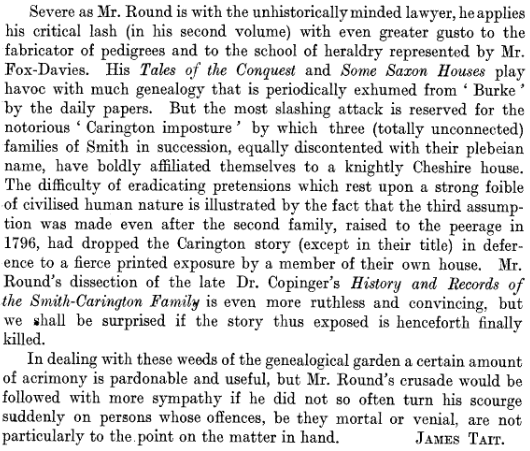
To quote James Tait (pub. Oct 1910, around the same time as Round’s Perrage and Pedigree, Vol II):
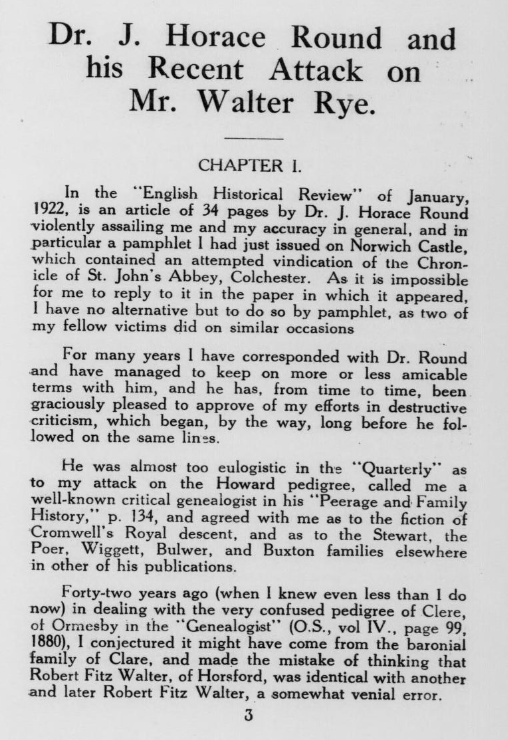
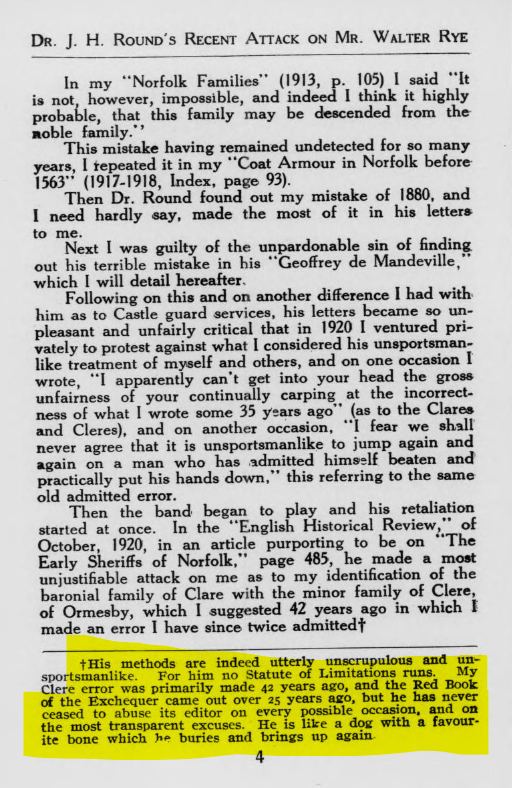
Another item that records Round’s penchant for unjust inflammatory attacks can be found in “Dr. J.H. Round’s Recent Attack on Mr. Walter Rye“.
To quote Compton Reade on the subject of the Cropwell Boteler Smiths,
- “It is a coincidence, and one with which genealogists are continually confronted, that in the registers of the same parish are found names identical, yet not of the same blood. Thus the registers of Plumtree, Notts, are full of the Cropwell Boteler [also Tithby] yeomen Smiths. Nevertheless, some years after their departure from the parish, a gentleman bearing their name, though really Carington, becomes a resident landowner. It was probably this fact that caused Mr. Augustus Smith to reject the Smith-Carington pedigree, assuming apparently that every Smith of Plumtree must be allied to Cropwell. Quod non constat. [Which is not agreed.]”
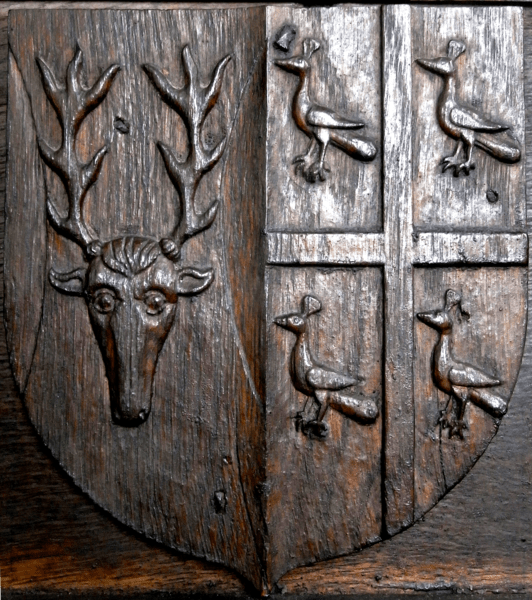
For reference, lest a visual aid even further muddle this story (descriptions at bottom of image):
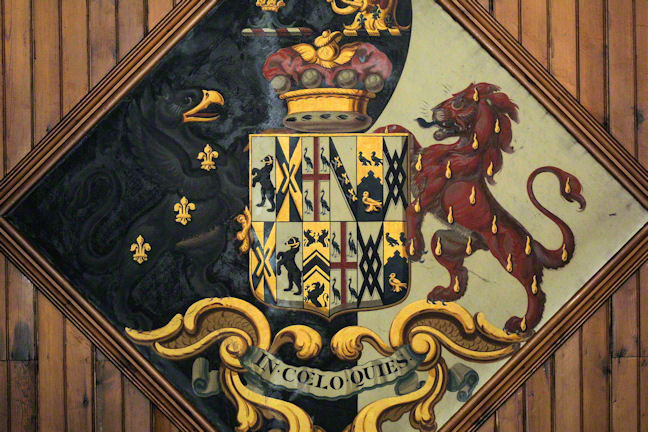
We see here, in these arms, allusions to the one ancestral narrative Round can prove, as can I, to be a fabrication. I will note that even these arms, however, do not place the peacocks at the far top left corner, as is usually done with the bearer’s direct male line’s ancestry.
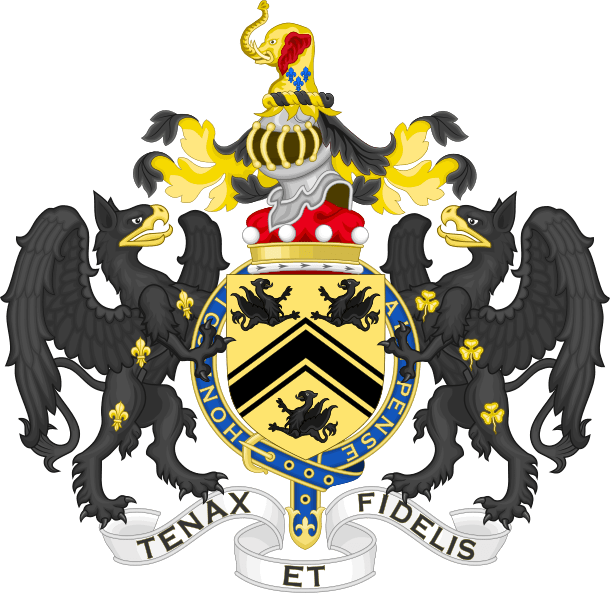
This Smith line more recently corrects their arms with this design, using solely the three griffins and chevron and elephant’s head for a crest (nothing remains at issue here):
And an interesting thread from soc.genealogy.medieval leads to:
- Per Surtees’s Durham, Vol. 3 (1823), the Pedigree of Blakiston, of Blakiston
- “Mary Blakiston = Sir Thomas Smith, of Broxton, co. Notts. Knt. , and had 4 sons with him, all living in 1669″
- “[Mary was a] dau of ‘Sir Thomas Blakiston Baronet = Mary Constable’”
I will say that it appears that “Brad” had initially mixed up the identity of Sir Thomas Smith of Broxton Hall (m. Mary Blakiston) with Thomas Smith, a cloth mercer [2], and brother of Samuel and Abel Smith, all three being founders of Smith Bank & Co. Remember, we can prove with visitation records that Thomas Smith, mercer, was descended from the Smiths of Cropwell Boteler near Tithby, co. Notts., not the Smiths of Wooten Wawen and Ashby Folville in Leicestershire. “Brad” later goes on to say “it seems quite likely that Broxtowe & Broxton were indeed one & the same or possibly shared a common origin”.
Note: Is this WikiPedia page incorrect too?
Continuing in my observations…
An invalid weight
Details of Robert Smith of A[l]sworth, Notts.
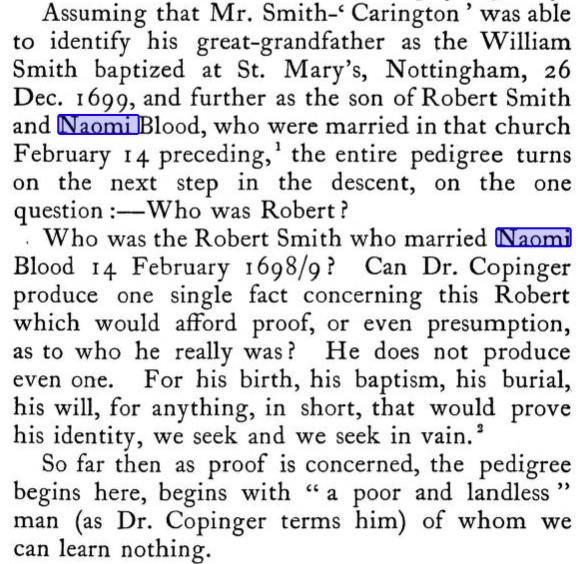
Round’s words:
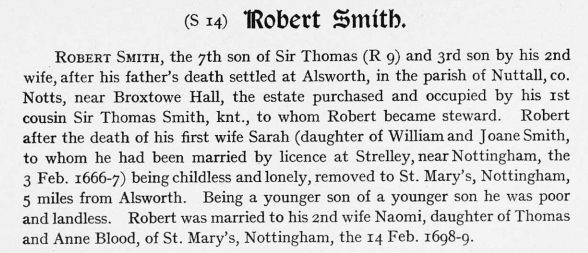
From Copinger:
I have found the following summarized argument against the Smith-Carington lineage in “Notes and Queries” from Oxford University Press, 1907:
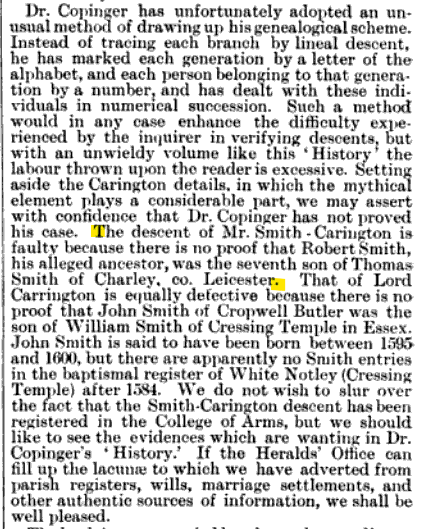
The mentioned Robert Smith married Naomi Blood.
My main concern on this subject is that lack of evidence is being used as proof of the contrary of a supposition. Fires, floods, etc… can destroy archives. I am not sure how one would explore the possibility of whether the archives of the involved areas have experienced losses such as these. Round was looking for records that were likely created over 240 years prior to his search for them.
Among the Nottingham Parish Registers, we find the first marriage that could be for “Robert Smith of Alsworth”:
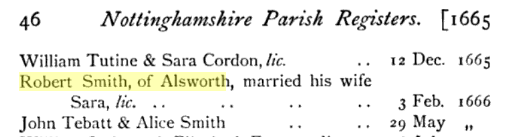

Abstracts of Nottinghamshire Marriage Licences
This marriage record differs from what Dr. Copinger presents. Sarah is “Sarah Abbott”. Who then, referring to Copinger, were William and Joane Smith?
New questions aside, we should keep in mind that 1) Richard Smith-Carington’s claim of descent is from Robert’s suggested second marriage, not his first. 2) Further, we would still need to ensure that Sarah Abbott had not been previously married, Abbott possibly being her married surname. I struggle to find sources that may be able to explore that question.
Further still, I wonder if it could be possible that a previous researcher had intertwined the identities of two different Robert Smiths and this was later assumed as accurate by Richard Smith-Carington and Dr. Copinger? I’ve seen such a thing happen in my modern research, but we would need rather explicit evidence in Richard Smith-Carington’s story. 3) How do we prove that the Robert Smith who married Sarah Abbott was the same Robert Smith who married Naomi Blood?
Round examines this question with an examination of the “Carlos Pedigree” on pages 231 to 235.
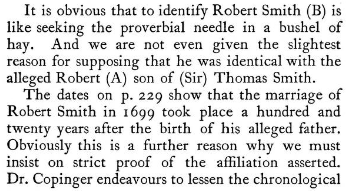
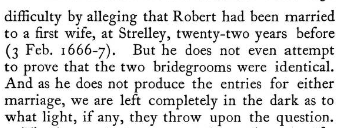
Further, regarding Sir Thomas Smith:
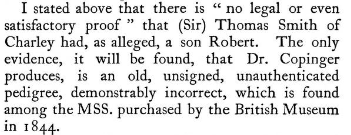
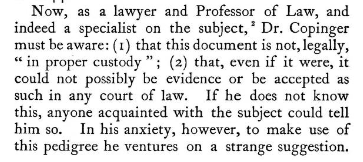
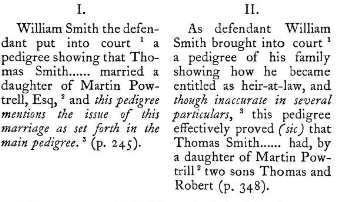
I wonder if Round places too much weight on the “chain of custody”?
Robert Smith’s second(?) marriage:
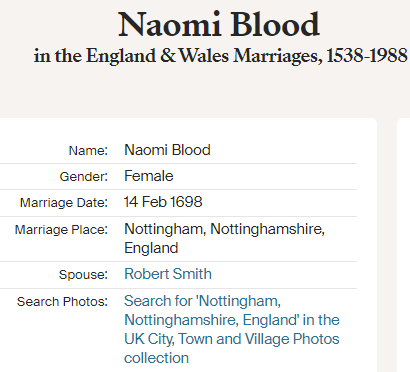
I do find among the christening records of St. Mary’s a child, William Smith, whose parents were a Robert and Naomi Smith.
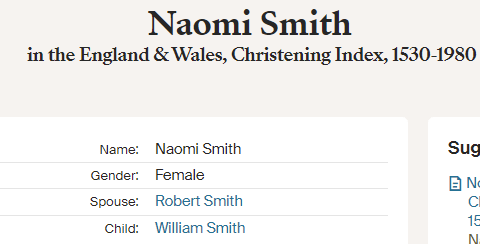
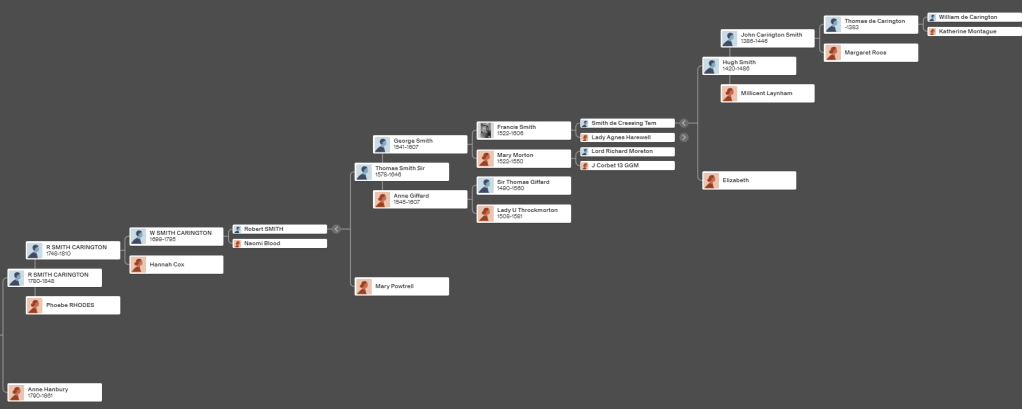
Unresolved is any evidence that the two Robert Smiths were the same person.
I do find this record of a Richard Smith in East Lake, specifically the Brickliffe Field area. Not sure if the same as the Richard Smith who married Phoebe Rhodes.
Exploring the Nottingham information
Again, from Copinger:
For reference:
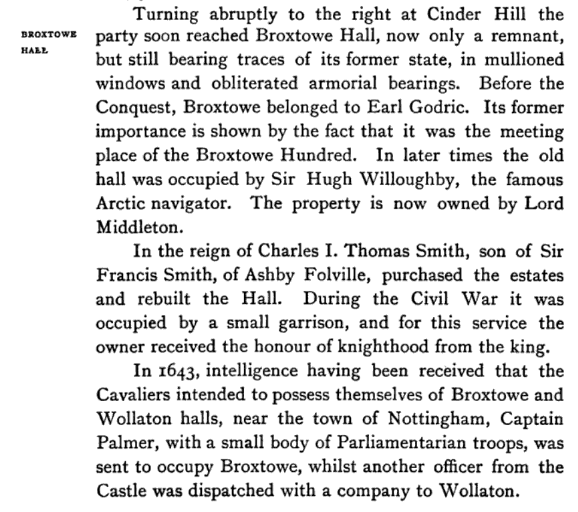
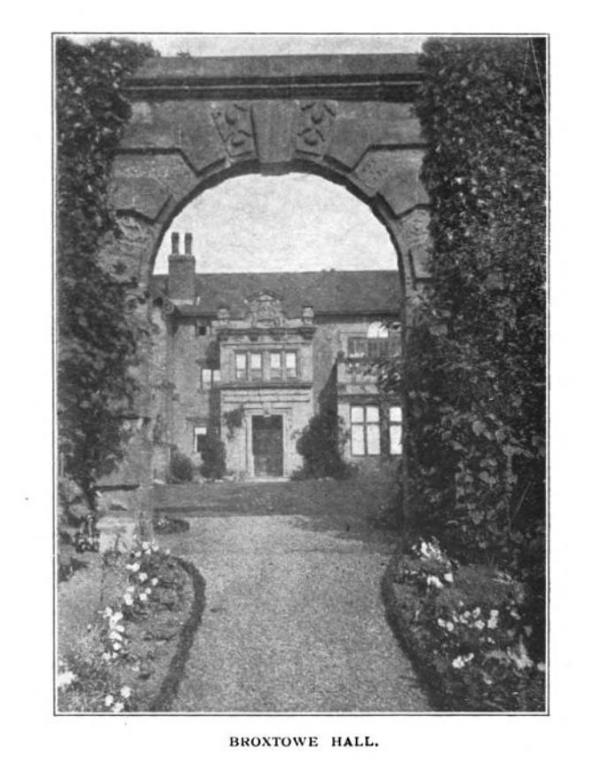
A bit of info on Broxtowe Hall:
From the Thoroton Society pub. 1907 [link 2]:
From “Rambles round Nottingham” by William Wallace Fyfe pub 1856:
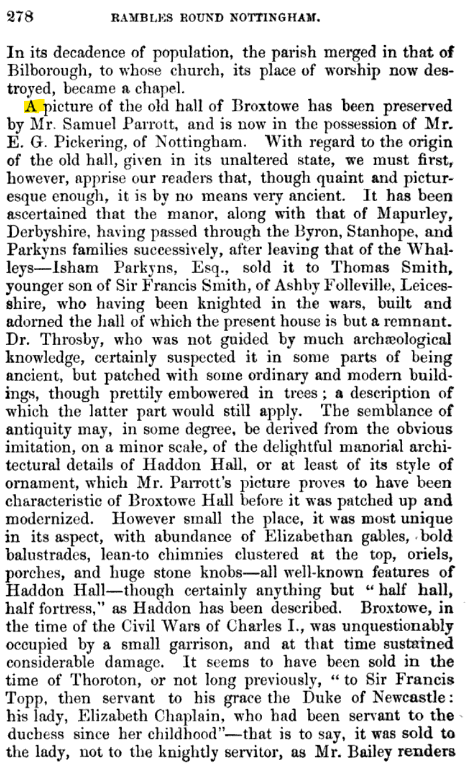
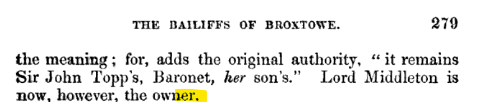
Sir Francis Topp appears to have been “Baronet of Tormarton”. His daughter Frances married Charles Stanhope, Esq. (of Stoke and Mansfield, line of 1st Earl of Chesterfield, temp. Charles II).
From Stephen Whatley, an earlier source for the sale of Broxtowe (Broxtow or Broculstow) [link]:
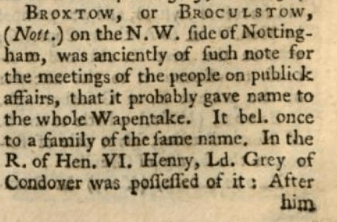
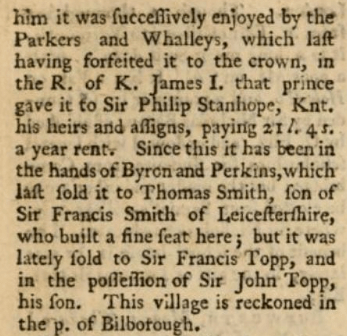
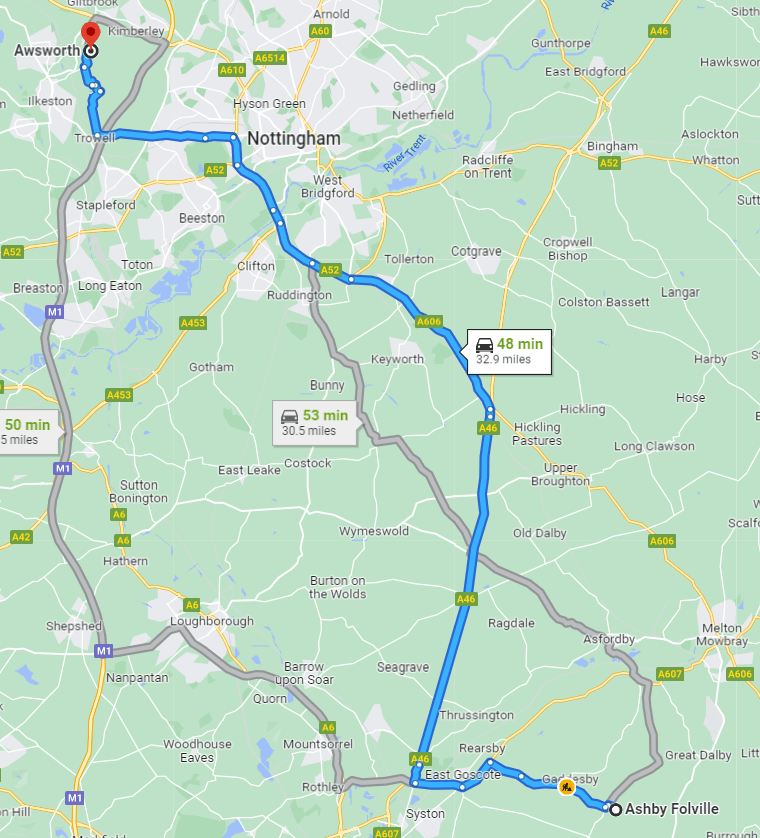
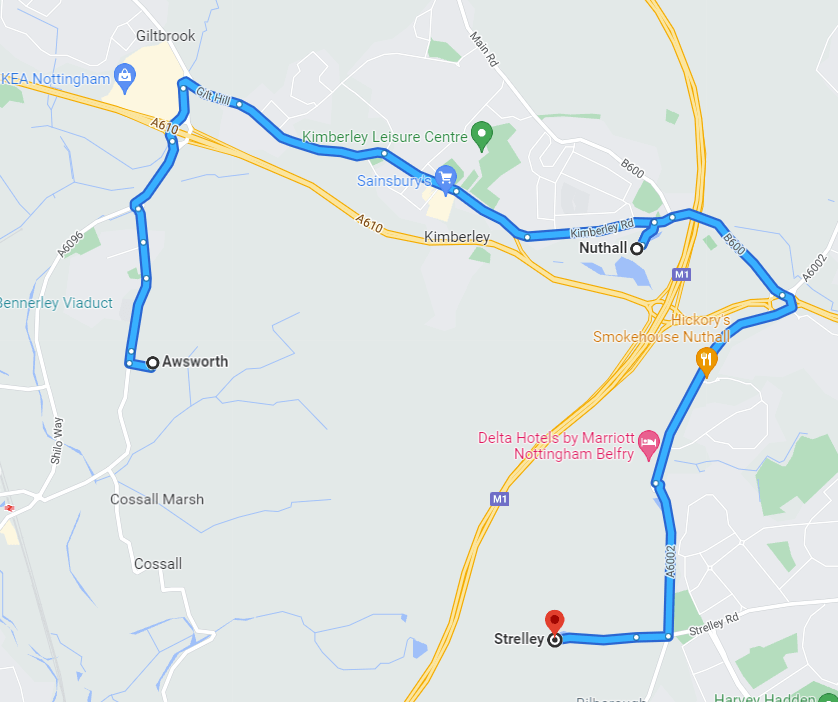
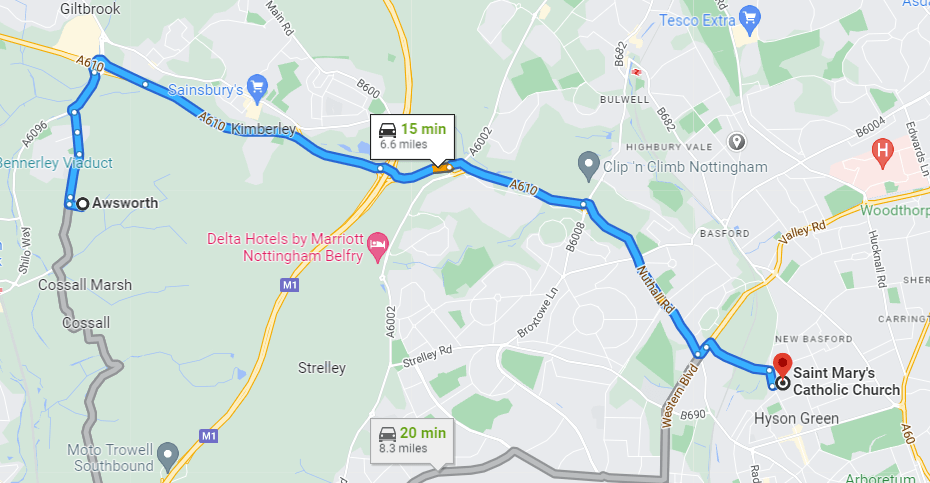
I believe what this information can support is that there clearly was a Sir Thomas Smith who held Broxtowe Hall in Nuthall, Nottinghamshire and that he was descended from Sir Francis Smith of Wooten Wawen, co. Warwickshire. Nuthall is, by today’s roads, only 3.4 miles from Awsworth, co. Notts. Strelley and Nuthall are only 2.8 miles from each other. This seems to be an appropriate and realistic neighborhood in which this story of Robert Smith of A[l]sworth to have taken place.
Back to Robert Smith of A[l]sworth…
I will mention that Compton Reade has Robert Smith of A[l]sworth as Thomas and Jane’s 3rd son. Robert would have been Jane’s 3rd but Thomas’ 7th son as she was his second wife. I’m not sure who Reade is using as a source.
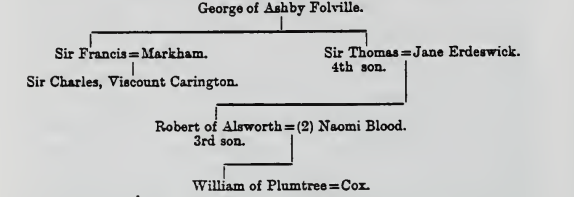
Further information:
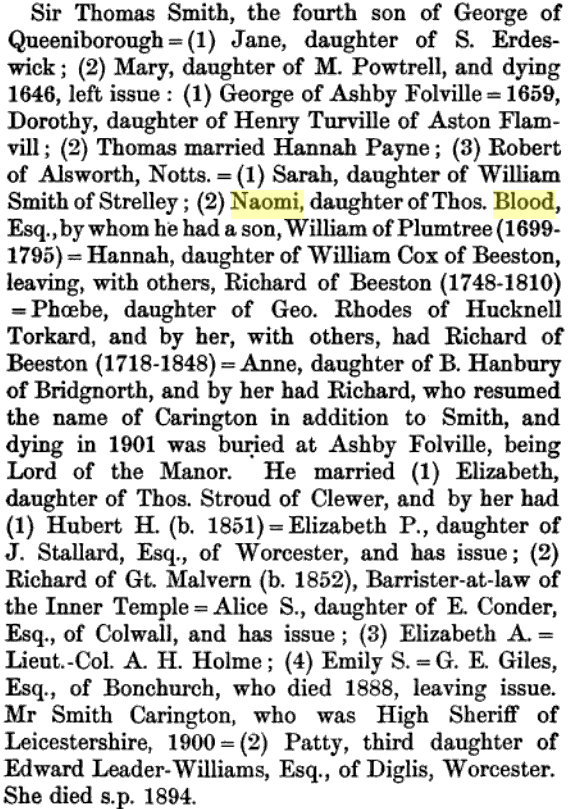
This page is also worth a perusal.
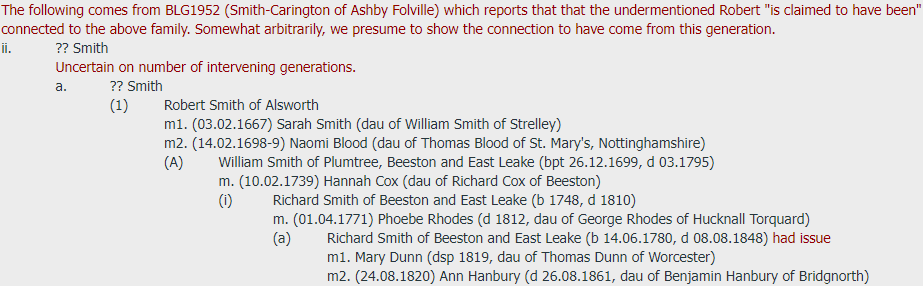
Burke’s take on things (pub. 1898):

I find Sir Thomas Smith described as:
“of Staffordshire”
“of Charley, co. Leicestershire”
“of Snelston, co. Derby”
Perhaps a local examination of the records of the following could yield some new clues about Robert Smith (m. Naomi Blood)?
Sampson Erdeswick of Sandon
Martin Powtrell of Sandford
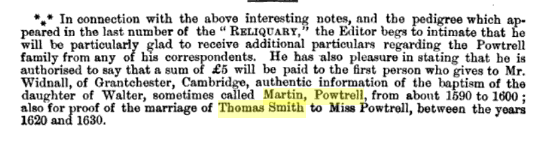
The best details I have found for Thomas Smith, suggested father of Robert Smith of A[l]wsworth is “Leicestershire Pedgrees and Royal Descents” by William George Dimock Fletcher (pub. 1887):

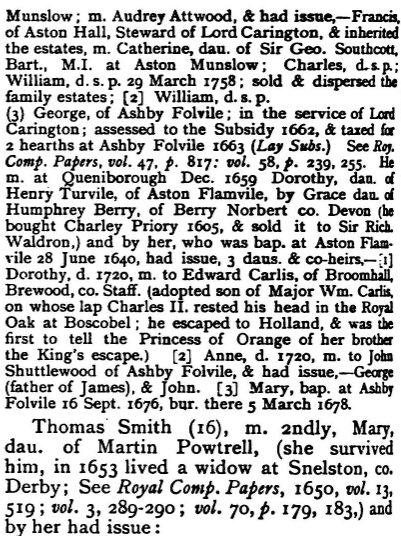
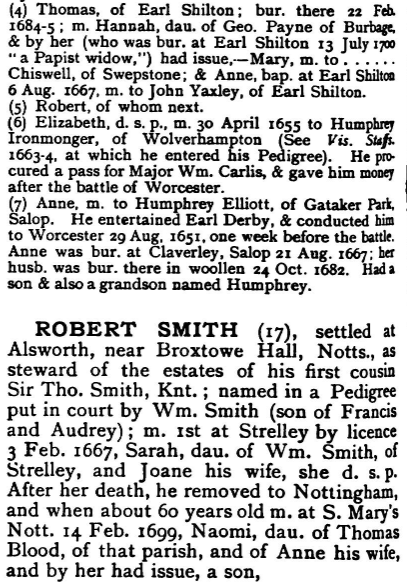
Was Round wrong about the pedigree of Richard Smith-Carington? I’ll let you decide.
To the matter of arms
- “On those arms I have much to say and we may here fitly examine the whole question of the heraldry. The old coat of the Cheshire Caringtons, which has thus been assumed, as their first ‘quarter’, by the Smith-Carington family, has never been in doubt. It is “sable, on a bend argent three lozenges of the first”, as is proved by the ‘Ballard’ roll (temp. Edward IV)”[1][2], by drawings of the windows in Bowdon Church (1530), and by a seal of William (de Ca)ryngton which Ormerod stated, in 1816, was affixed to a charter of 47 Edward III (1373-74). On this seal, Dr. Copinger comments that “The date of the charter 20 Dec 1374 proves the use of these arms for upwards of 530 years. (Cop p.41)”
Notes: search for “Ballard’s Roll of Arms” in Google. Can’t find an eBook unfortunately. It’s not in WorldCat either. It’s definitely real though. For reference, Round published in 1910. From Leicestershire Pedigrees and Royal Descents, “Richard Smith Carington of St. Cloud, near Worcester; resumed the old family name, by Deed Poll, 25 March 1878*; J.P. for Worc., and F.S.A.”
- “Now this is a misleading statement. The ‘Smith-Carington‘ family do not appear to have assumed them till late Victorian days* [20 Jun 1837 to 22 Jan 1901], while the Essex Smiths, through whom they claim their ‘Carington’ descent, do not even appear to have ever used them at all!”
I will agree that Copinger probably mis-states how long the Carrington arms were continually in use.
Perhaps he had encountered the work of Henry Sydney Grazebrook:
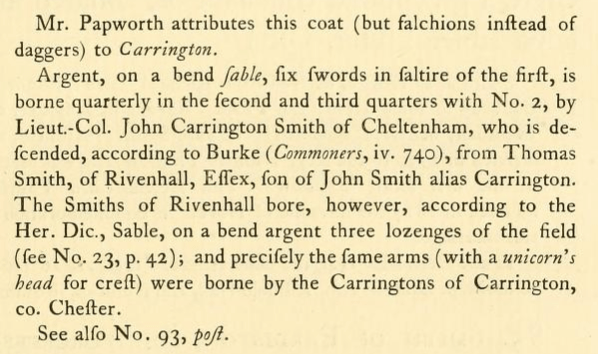
I am skeptical of the quality of information in this book.
Grazebrook refers to this man, Lt. Col. John Carrington Smith [his will, a memorial] who married Hon. Charlotte Juliana Butler, a daughter of a Viscount Mountgarrett (whose son, Juliana’s brother, also held the title of Earl of Kilkenny):
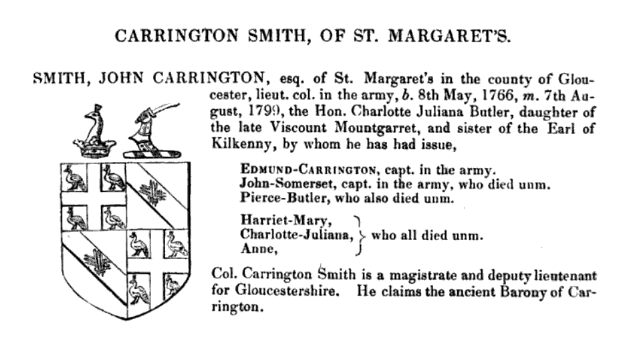
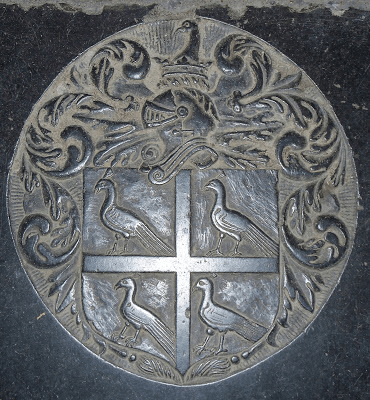
WikiPedia page for Sir Clement Smith
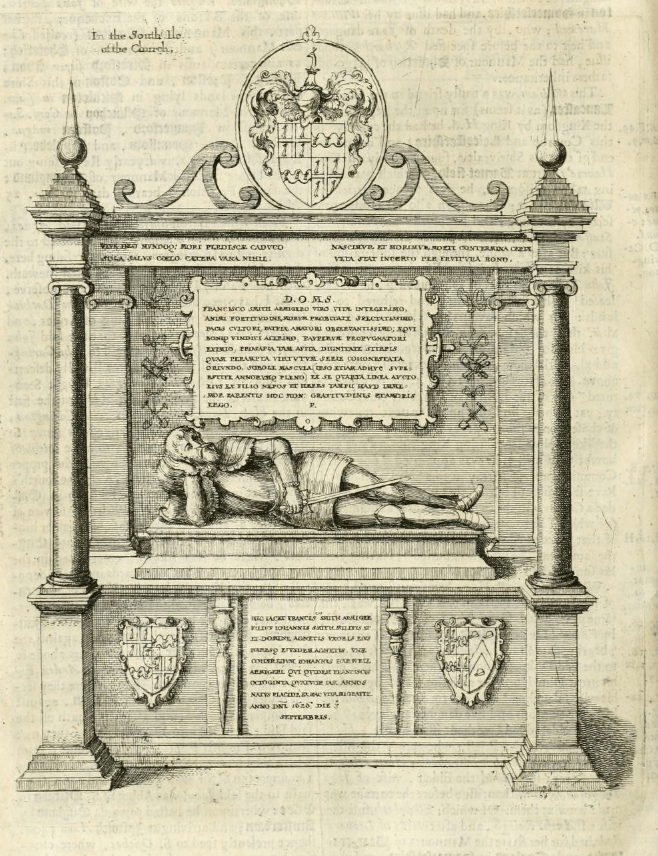
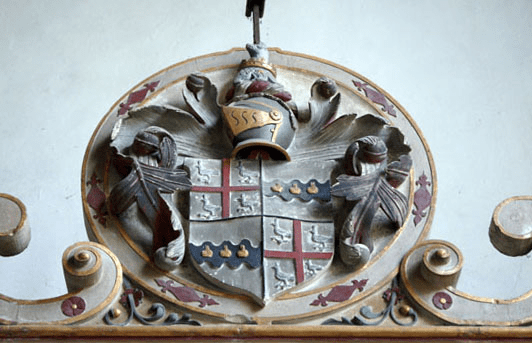
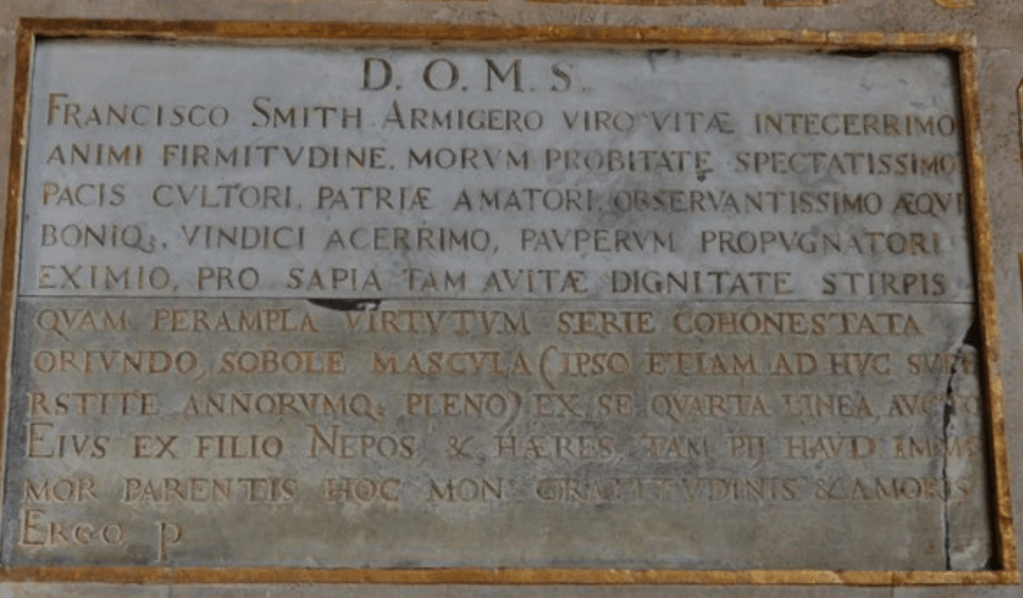
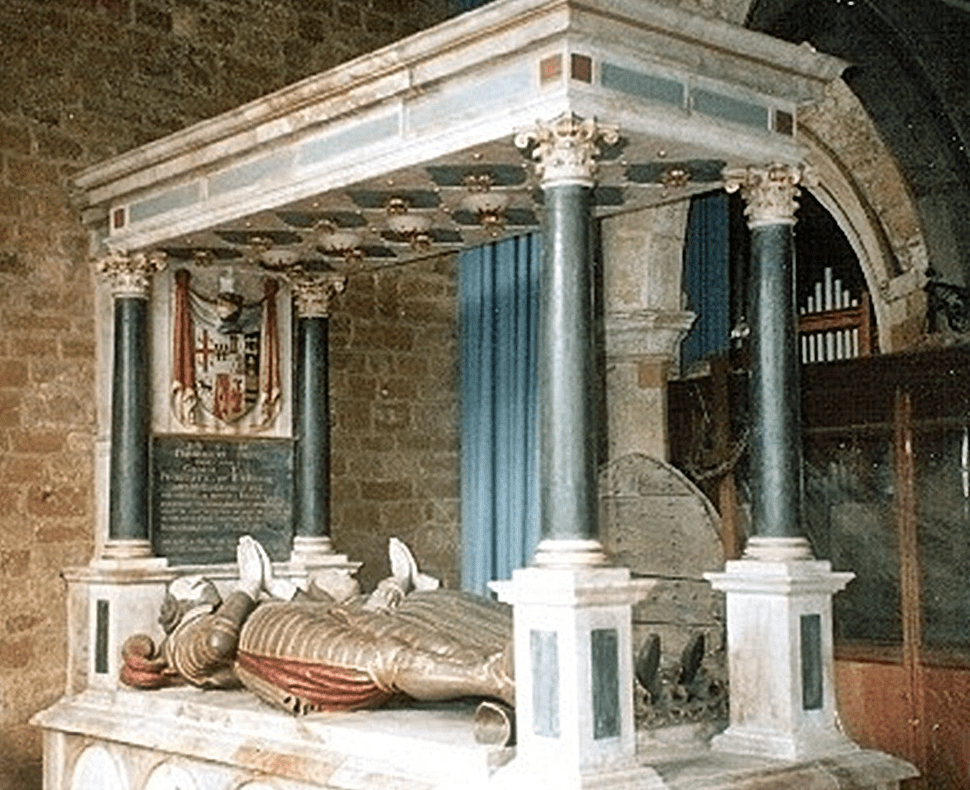
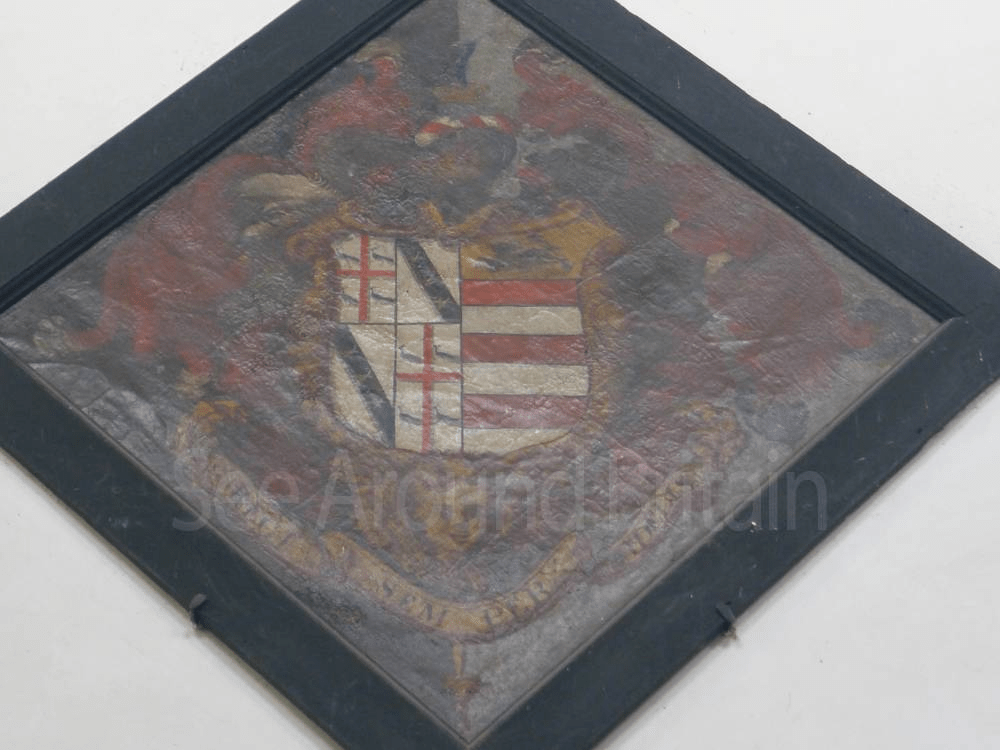
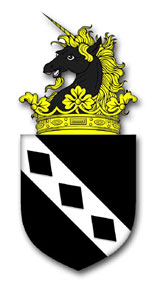
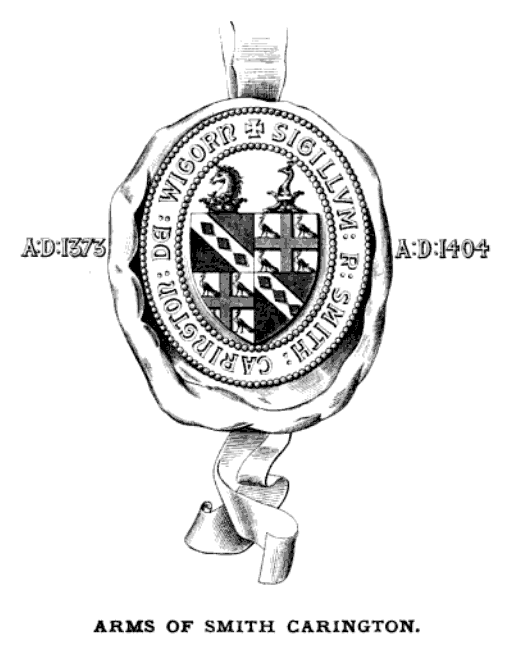

Further sources:
Also: https://europeanheraldry.org/united-kingdom/families/families-f/house-carington/
Side project: For this Smith line of Ashby-Folville in Leicester, I can say with certainty that Richard Smith-Carington’s 2x-great-grandson (specific identity will not be disclosed here) is on Ancestry.com. I have asked him to do yDNA testing but I have unfortunately not yet received a reply to my initial efforts to contact him. I’ll be sure to update here if anything comes of this, which I hope it does.
Old wine in new bottles? Or new labels on old wine?
It is about these arms of Richard Smith-Carrington’s family Round makes a fuss. He claims that Richard Smith-Carington’s quartering of the Carrington arms is suspect based on the fact that the Smiths of Rivenhall did not include them in theirs. Round does confirm that the Garter King of Arms at the time had not “officially sanctioned their assumption”. Oh well.
Sir John Smith, Baron to the Exchequer used both, but not at the same time, “Argent, on a chevron sable 6 fleurs-de-lis or ; on a chief, of the second, a lion passant of the first” and later on, the peacocks of Smiths of Rivenhall. (Round Vol II p.186)
- “On investigation we discover that Sir John Smith, as ‘of Cressing’, was acutally granted a coat by Barker, Garter King of Arms (1536-1549), a fact which proves conclusively that he had not inherited, as alleged, from his grandfather, the cross and peacocks coat, but knew himself to be a novus homo with no hereditary rights to arms.”
- “This discovery is the key to the whole heraldry of the family.”
I feel, here, Round has made his most glaring error. A simple inquiry to the UK’s College of Arms sheds some light on the matter. My original e-mail was not preserved in the web form through which it was submitted, but the return was. The important bit:
- “In certain circumstances, it may be possible for a person who has a right to arms to petition for a new grant of different arms in lieu of those to which he had an inherited right. In many cases, illegitimate sons, who do not inherit a right to arms, have been granted arms similar in appearance to their father’s, with an additional element included for distinction.”
Not to digress too far away from my target, we can refer to the “The Law of Arms in Mediaeval England“:
- “By the reign of Henry III [1207-1272], coats of arms were being inherited; previously, sons could take whatever design they preferred.”
Additionally,
- “In 1417, Henry V proclaimed the first criminal law in heraldic law: he outlawed the practice of [self-]assuming [as opposed to being granted] coats of arms. The proclamation also empowered the sheriffs or other representatives of the king to deface the malefactor’s coat of arms, wherever it may have been-on his banner, his shield, or other chattels.(75) The proclamation was related to the practice of heraldic visitations, which, though its earliest records date from the reign of Edward IV, probably goes as far back as the reign of Henry V.”
It is important to keep in mind that the story of John Smith of Rivenhall, adventurer and would-be assassin of Henry IV, includes his name change from Carrington to Smith taking place in 1403, shortly after his return from Milan, Italy. He fled England due to his involvement in the Epiphany Rising Plot.
We can likely assume then that John Smith of Rivenhall was granted his arms just 14 years prior to a period of strict application of heraldic law, and as he and his family continued to use them, they must have been doing so legally, explicitly. Further, I believe we have credible sources that show there would be nothing that would prevent the issuance of new arms (Smith) to a man who had, at the time, an existing hereditary right to the arms of his father (Carrington). This point applies to two of Round’s attacks, 1) Sir John Smith, Exchequer to Henry VIII and 2) Smiths of Rivenhall.
We see a similar contrast between a) the accusations that there was a rogue 16th century herald who fabricated the pedigree of John Smith of Rivenhall and b) the state of Heraldic Law at the time. According to The College of Arms:
- Brooke argued that these coats of arms were granted to unworthy or deceased individuals or were too similar to other previously issued arms.
- I see no mention in the page I link to above of incorrect or forged pedigrees (anyone have a transcript?).
From the College of Arms website:
- “Between 1530 and 1689 the Kings of Arms were given Royal Commissions to visit English and Welsh counties, to establish that arms were borne with proper authority. Anyone found using arms without entitlement was forced to make a public disclaimer.”
Where are the archives of these “public disclaimers”? (Most of the Heraldic Visitations are available on Google Books.)
Why then are the Heralds being accused, by some, of doing the very thing their king is ordering them to remedy?
I did run across one herald, not Cooke, who was allegedly beheaded due to his forging the seal of the Garter King at Arms. I can’t find the article now that I’m writing this post. If you know his name and story, leave a message.
Returning to Round:
- “But these, the old Carington arms, are by no means the only coat assigned to the family by the author. Indeed he speaks (Cop p. 4) of their “having at least at various times borne four different coat of arms”, while the great shield which forms his frontispiece actually displays six!”
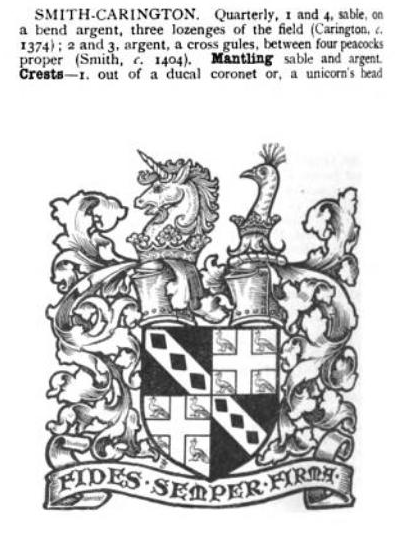
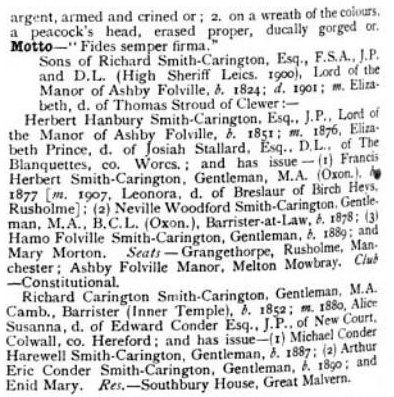
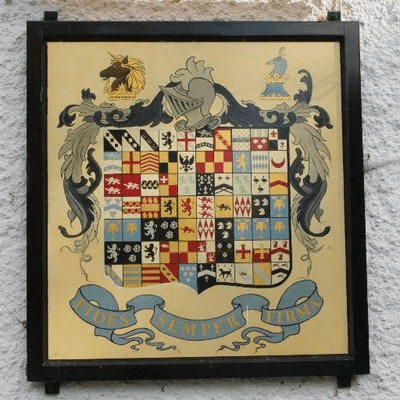
In referring to the “frontispeice”, we’re lucky enough to have a visual aid. Richard Smith-Carington has quite the assortment. The first 6 in the top left quarter are those arms to which Round refers:
Alternatively, from Copinger’s book:
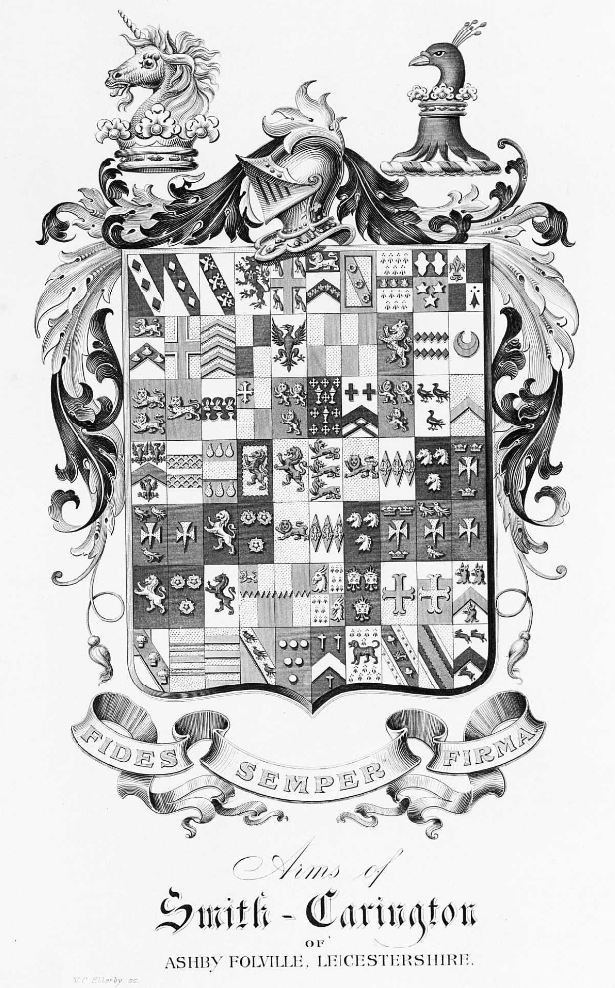
- “After the true Carington coat we have, (2 and 3) two variants thereof; then (4) a coat assigned to a medieval Sir Philip Carington; (5) the coat that was actually borne by the descendants of Sir John Smith (Baron of the Exchequer), and (6) the coat borne by Sir John Smith himself – which was totally different from any of the foregoing. These coats are thus marshalled in accordance with a vicious practice of heralds, who often, when a family had formerly borne a different coat, (or was alleged to have done so) added it, as a quartering, to the coat in use.”
So the main argument Round makes here is that since descendants of Sir John Smith, Baron of the Exchequer under Henry VIII, bore different arms than Smiths of Cressing Temple, the family from which Sir John Smith descended, there must be some impropriety on the part of the Heralds and Sir John Smith must not be descended from whom he claimed. However, again referring to my recent reply from the College of Arms, there is nothing that would prevent a man from being issued arms different from his father, if the circumstances are appropriate. Sir Clement Smith of Little Baddow was brother-in-law to Henry VIII and Sir John Smith was now Henry’s accountant. Maybe there was some desire on John’s part to have arms that distanced him from the story of his ancestor plotting to kill Henry IV while he was under the king’s employ? Or maybe it was a class level “boost” now that he was handling the king’s money? Just speculations on my part, but both equally credible, in my opinion, as to why he may have been free to bear two different coats of arms. One for personal matters, one for business.
An interesting item is the longevity of this doubt of the Carrington alias Smith story. Round (pub. 1910) cites George Edward Cokayne (G.E.C.) on page 186. Cokayne (pub. 1892) (sounds like Cocaine??) cites “Vincent’s Leicestershire” (pub. 1619).
- “I cannot but feare this descent from which ye Smiths of Ashby Folvill and others of that name derive themselves; because it is scarce know that , upon any occasion, both name and arms should be changed, and Sir John Smith, Knt., Baron of ye Exchequer gave first [as the armorial ensigns of this family] Argent, on a chevron sable 6 fleurs-de-lis or; on a cheif, of the second, a lion passant of the first and then, after many years, ye issue of him have [as such armorial ensigns] ye cross, between 4 peacocks proper; and now they flye to Carrington sed quo jure penitus ignoro [translation: but by what right I do not know].”
Round goes on to state:
- “Dr. Copinger, therefore, cannot plead that the tale he accepts as unquestionably true is one which has never before aroused suspicion.”
Here, Round argues that Copinger should not trust the Carrington alias Smith story because it looks suspicious. Where ever from Round and Vincent sourced their material, I am surprised they were not familiar with the aforementioned concepts that the right to hereditary inheritance of arms does not explicitly and wholly dictate what arms a man can or will bear, if any at all, nor do coat of arms have any wholly weighted explicit significance on the credibility or accuracy of a person’s documented ancestry.
Closing thoughts
Even if Richard Smith-Carington’s (re-?)adoption of the Carrington arms was “off the books”, this alone does not discredit his family’s claim of descent from the Smiths of Cressing Temple. That said, I can not say with certainty that countering Round’s armorial analysis proves his descent either. For that, we would need a thorough examination of the relevant vestry and legal records in Nottinghamshire for the time and place of Robert Smith of A[l]wsworth. I feel that “Leicestershire Pedgrees and Royal Descents” by William George Dimock Fletcher (pub. 1887) provides high quality references for the familial relationship between Robert Smith of A[l]wsworth, co. Notts. and the family of Francis Smith and Audrey Attwood, descendants of Sir Thomas Smith who was allegedly knighted by Charles I. Finding a means to verify Fletcher’s sources will be challenging, but you’re welcome to assist.
If you’ve made it this far, I appreciate your interest in this story and thank you for your time.
Be safe,
Christopher A. Smith
 Tracing my Smiths - by Christopher A. Smith - © 2021
